Python
Dataclasses
https://stackoverflow.com/questions/55307017/pickle-a-frozen-dataclass-that-has-slots
https://rednafi.com/python/statically_enforcing_frozen_dataclasses/
For dataclasses we can set frozen=True, slots=True:
from dataclasses import dataclass

@dataclass(frozen=True, slots=True)
class Frozen:
    x: int
    y: int
    l: list[int]  # <-- still mutable, use tuples instead
Set defaults:
from dataclasses import dataclass, field

@dataclass
class A:
    x: int = 0
    y: int = field(default=0)  # same as x
Validation approaches:
Use
__post_init__- Adding all logic to__init__: example - Definingvalidate_*functions and calling them in a loop in__post_init__: src - Instead ofvalidate_*functions you can use metadata, like thisage: int = field(metadata={"validate": lambda value: value > 0})- Type checking is somewhat tricky (here is a simpler non-recursive type-checking version), use 3rd party libraries insteadFor mutable dataclasses also define
__setattr__Use 3rd party libs like
pydantic,msgspec
Decorators
Primer on Python Decorators - multiple examples, but no info on typing decorators
Typing a decorator:
from functools import wraps
from typing import Callable, TypeVar, ParamSpec
from typing import reveal_type

ParamsTs = ParamSpec('ParamsTs')
ReturnT = TypeVar('ReturnT')

def debug(
  fun: Callable[ParamsTs, ReturnT],
) -> Callable[ParamsTs, ReturnT]:
  @wraps(fun)
  def inner(
    *args: ParamsTs.args,
    **kwargs: ParamsTs.kwargs,
  ) -> ReturnT:
    ...
    return fun(*args, **kwargs)
  return inner

@debug
def concat(a: str, b: str) -> str:
  """Concatenate two strings."""
  return a + b


reveal_type(concat)
# Revealed type is "def (a: str, b: str) -> str"

print(concat.__doc__)
# Will print: "Concatenate two strings."
Decorator having more or less arguments than decorated function:
from functools import wraps
from typing import Callable, Concatenate, ParamSpec, TypeVar

ParamsTs = ParamSpec('ParamsTs')
ReturnT = TypeVar('ReturnT')

class User: ...
class Request: ...
class Response: ...

def with_user(
  fun: Callable[Concatenate[User, ParamsTs], ReturnT],
) -> Callable[P, ReturnT]:
  @wraps(fun)
  def inner(*args: ParamsTs.args, **kwargs: ParamsTs.kwargs) -> ReturnT:
    user = User()
    return fun(user, *args, **kwargs)
  return inner

@with_user
def handle_request(
  user: User,
  request: Request,
) -> Response:
  ...

request = Request()
response = handle_request(request)
Immutability
Immutable structures
Immutable versions of standard types:
Immutable
lististuple.Immutable
setisfrozenset.Immutable
bytearrayisbytes.dictdoesn’t have an immutable version but it hastypes.MappingProxyTypewrapper that makes it immutable
from types import MappingProxyType

orig = {1: 2}
immut = MappingProxyType(orig)

immut[3] = 4
# TypeError: 'mappingproxy' object does not support item assignment

orig[3] = 4
immut[3]
# 4
For dataclasses we can set frozen=True, slots=True.
Refer to Dataclasses section for details and gotchas.
3rd party libraries:
Final type
MAX_SIZE: Final = 9000
MAX_SIZE += 1  # Error reported by type checker
Parsing
Faster, more memory-efficient Python JSON parsing with msgspec - For large files use ijson - Msgspec is used by litestar web framework (src: HN)
Dataclasses vs Attrs vs Pydantic
Pattern Matching
https://mathspp.com/blog/pydonts/structural-pattern-matching-tutorial
https://mathspp.com/blog/pydonts/structural-pattern-matching-anti-patterns
https://earthly.dev/blog/structural-pattern-matching-python/
https://www.infoworld.com/article/3609208/how-to-use-structural-pattern-matching-in-python.html
Memoization and Caching
String Formatting
# Print key=value
print(f"{key=}")

# Floats
pi = 3.141592
precision = 3
print(f"{pi:.{precision}f}") # "3.142"

# Percentage
val = 1.255
print(f"{val:%}")    # 125.500000%
print(f"{val:.0%}")  # 125%
print(f"{val:.1%}")  # 125.5%

# Scientific notation
val = 1.2345e3
print(f"{val:e}")    # 1.234500e+03
print(f"{val:E}")    # 1.234500E+03
print(f"{val:.2e}")  # 1.23e+03

# Integers
val = 1_000_000
print(f"{val:,d}")  # 1,000,000
print(f"{val:_d}")  # 1_000_000

# Numbers
val = 1
print(f"{val =: n}")  # val = 1

# Dates
day = date(year=2022, month=9, day=1)
print(f"{day}")
print(f"{day:%Y-%m-%d}")  # default appearance
print(f"{day:%Y/%m/%d}")  # use `/` as separator
print(f"{day:%Y %b %d}")  # 2022 Sep 01
print(f"{day:%Y %B %d}")  # 2022 September 01
print(f"{day:%Y %b %d (%A)}")  # 2022 Sep 01 (Thursday)

# Datetime
day_and_time = datetime(year=2022, month=9, day=1, hour=17, minute=30, second=45)
now = datetime.now()
print(f"{day_and_time}")                   # 2022-09-01 17:30:45
print(f"{now}")                            # 2022-12-08 15:49:37.810347
print(f"{now:%Y-%m-%d %H:%M:%S.%f}")       # 2022-12-08 15:49:37.810347
print(f"{now:%Y-%m-%d %H:%M:%S.%f}"[:22])  # 2022-12-08 15:49:37.81

# Padding
val = 1
print(f"{val:3d}")   # "  1"
print(f"{val:03d}")  # "001"

# Positive/negative sign
positive = 1.23
negative = -1.23
print(f"1: {positive:+.2f}   {negative:+.2f}")  # 1: +1.23   -1.23
print(f"2: {positive:-.2f}   {negative:-.2f}")  # 2: 1.23   -1.23
print(f"3: {positive: .2f}   {negative: .2f}")  # 3:  1.23   -1.23
Profiling
- plasma-umass/scalene
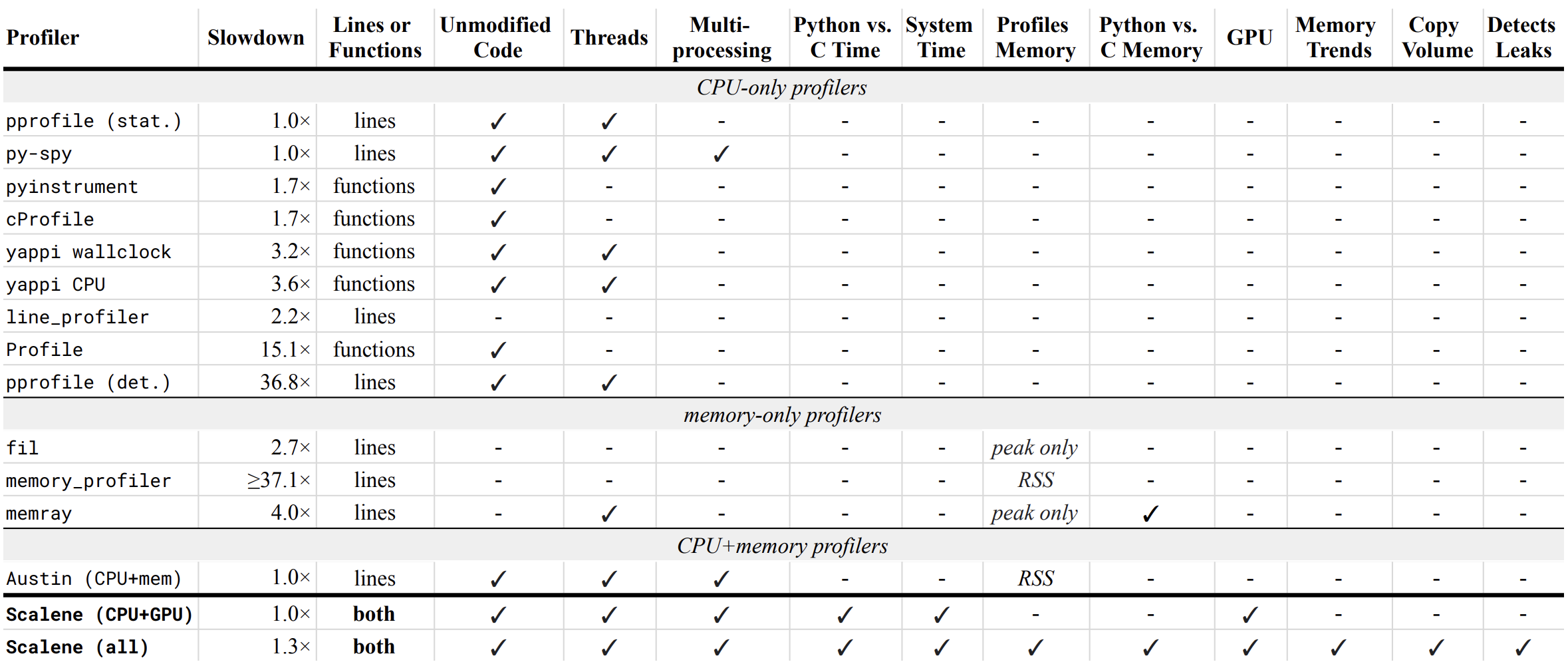
has comparison with other profilers: img
- bloomberg/memray
has pytest plugin
- joerick/pyinstrument
can integrate with FastAPI, call stack is available when
?profile=trueis added to the url